Velocert
Making digital credentialing simple for non-technical staff
July 2024 - Ongoing
Key outcomes
Designed both the SaaS platform and velocert.com from scratch • Whitelabel version created for Mondragon University • Presented at conferences all over Europe • Platform used to issue credentials at professional conferences • Inbound partnership requests from organisations all over the world, driven purely by the website
The problem
European Digital Credentials (EDCs) are the EU standard for tamper-proof, machine-readable diplomas, micro-credentials, and certificates. The problem is that the existing EU tool for creating and issuing them is painful to use. It exposes hundreds of data fields, most of which are irrelevant for any given use case, with no guidance on which ones matter. The result: institutions either avoid digital credentials entirely, or need dedicated IT support to issue them.
Velocert set out to make this process accessible to university admins, training coordinators, and professional organisations who have no technical background in credential standards. Pick a template, customise it, import your recipients, send. That was the target experience.

EU's EDC credential builder. Screenshot showing fields already 3 levels deep.
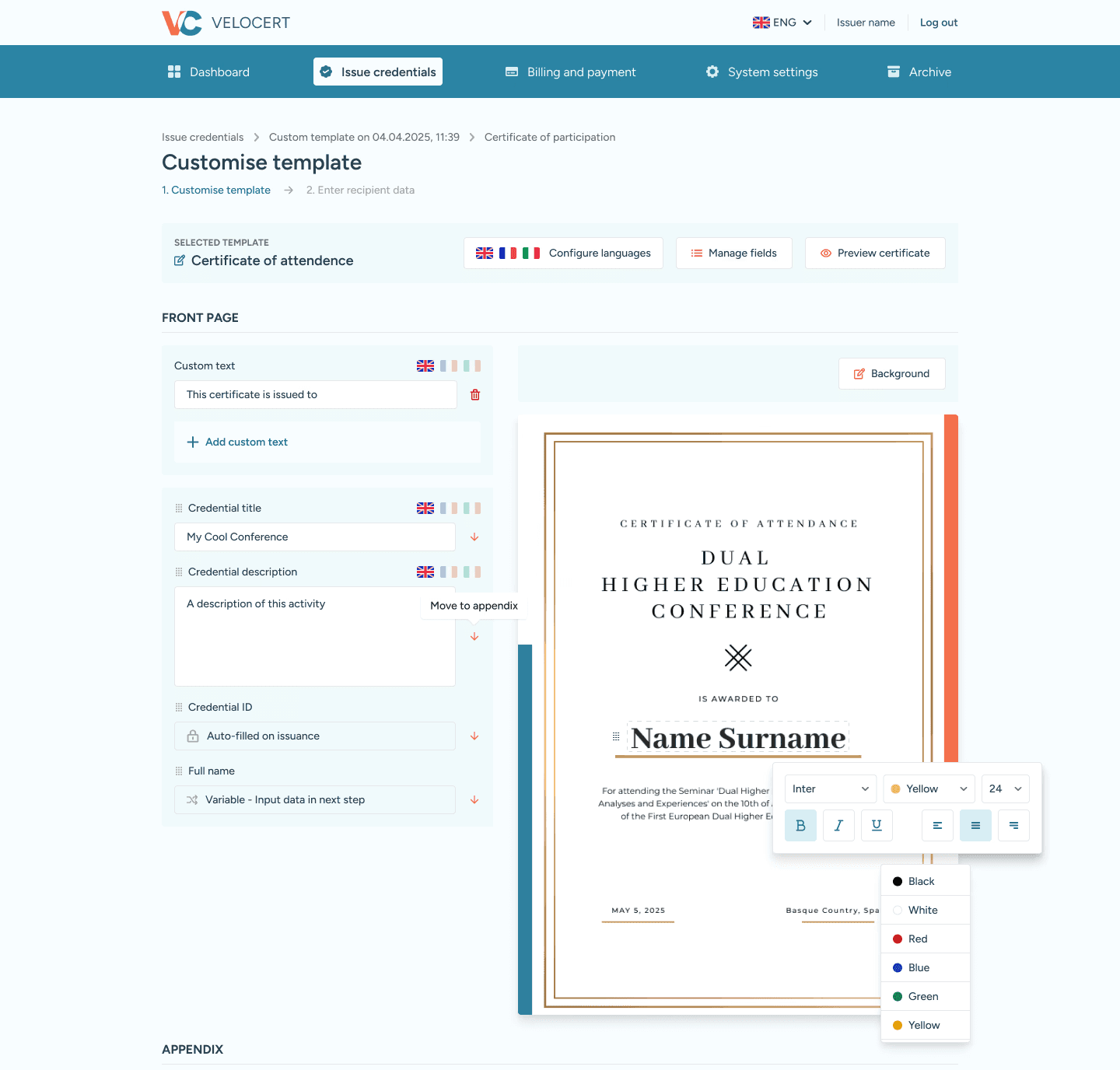
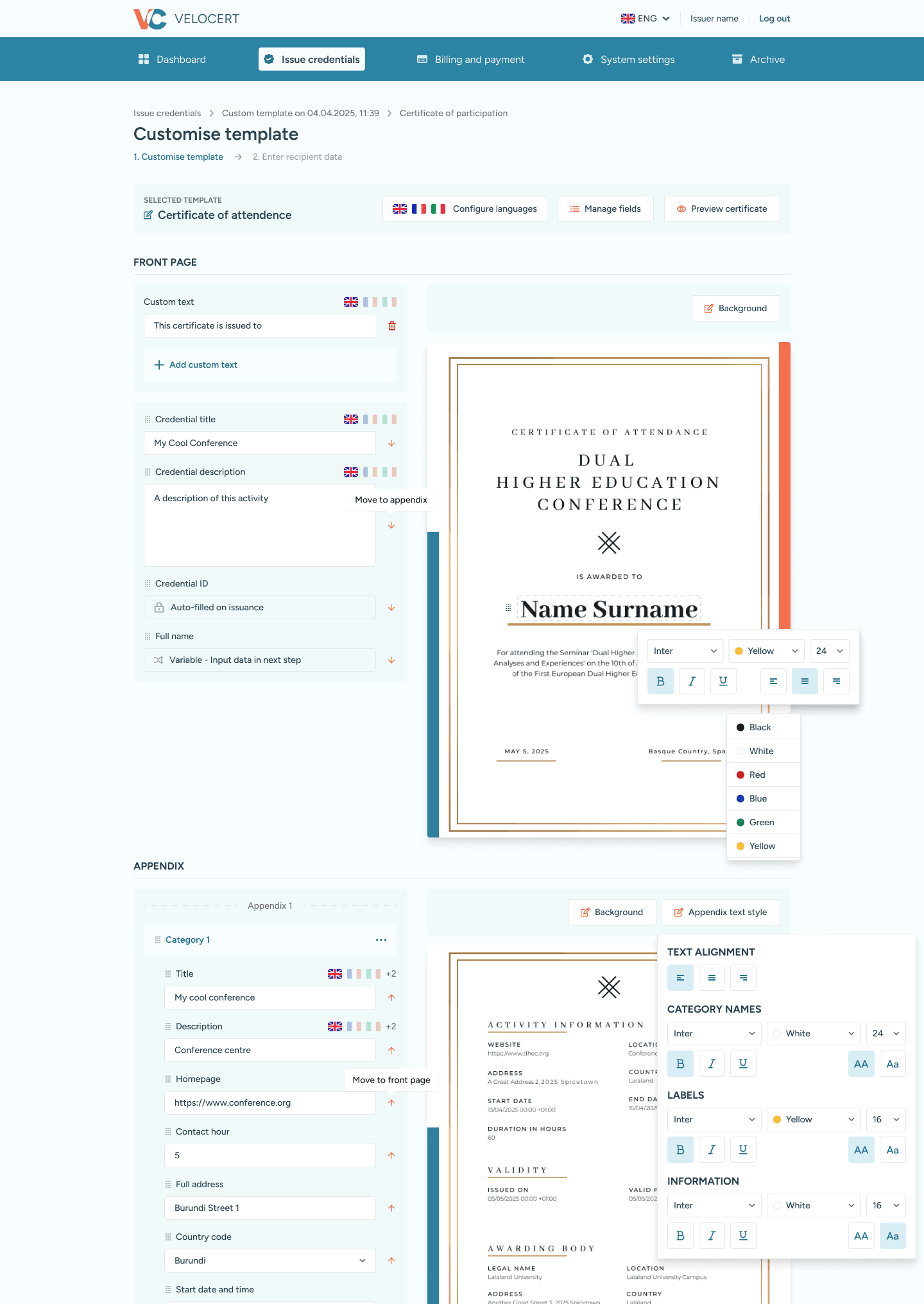
Velocert's credential builder
The approach
Taming the field complexity
The EU's credential data model has a massive number of fields. But a certificate of attendance needs very different information than a diploma supplement or a micro-credential. Rather than dumping all fields on the user and hoping for the best, we built pre-configured templates, each with a curated set of fields appropriate for that credential type. Users who need more control can open a "manage fields" menu to show/hide fields or toggle them between "same for all recipients" and "variable" (meaning the value changes per credential, like a recipient's name). This layered approach serves the 90% who want simplicity without blocking the 10% who need flexibility.
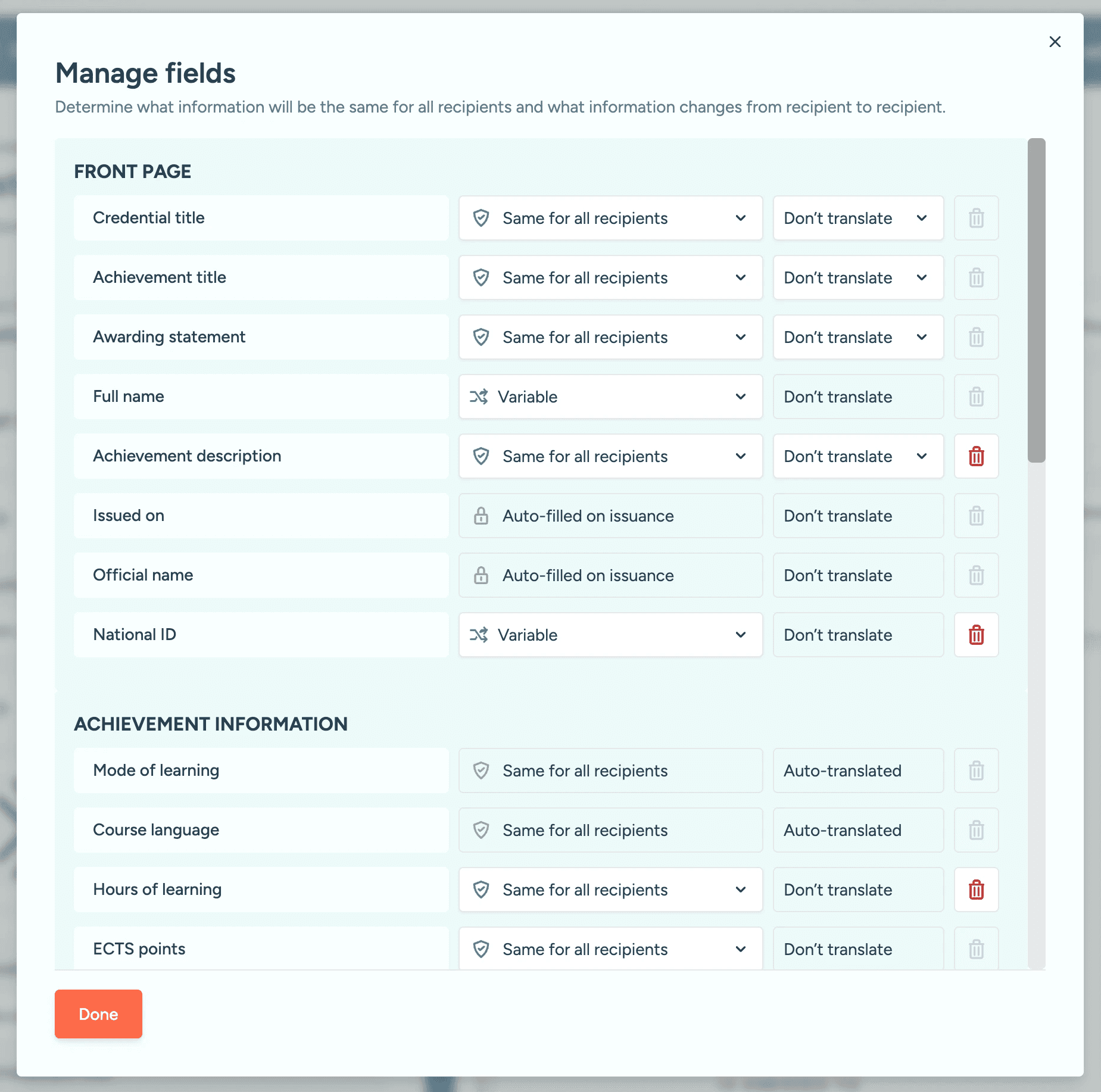
The "Manage fields" modal
Balancing customisation with quality
Institutions want their credentials to look like theirs, not generic. But too much styling freedom leads to ugly results. We solved this by splitting control: the front page of the credential (the visual certificate) allows full customisation of layout and styling. The inner pages, which contain structured data, only allow styling in blocks. Labels have one style, data values have another, titles have another. This keeps the structured content legible and professional while still giving institutions ownership of the visual identity.
Designing the product website
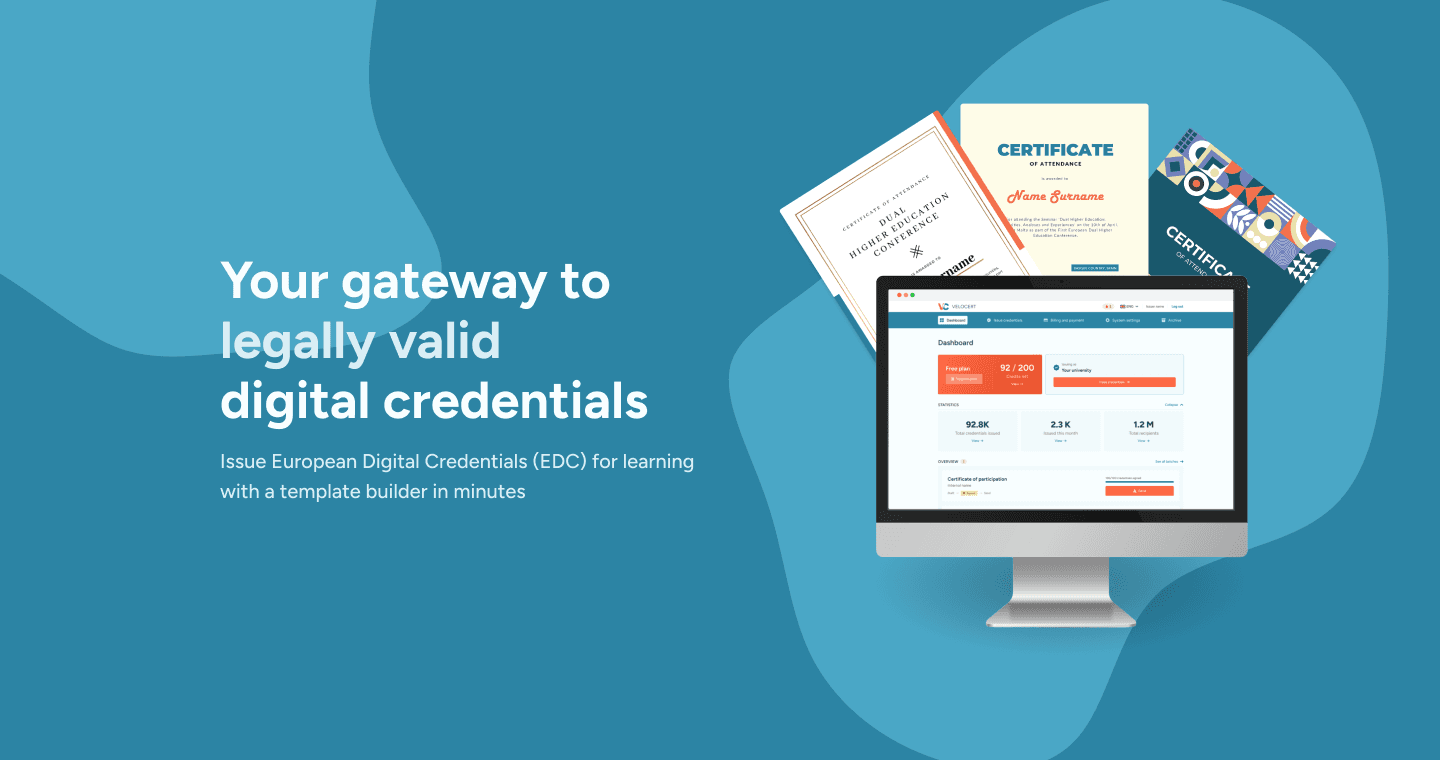
I also designed velocert.com, building out the visual language (including the blob shapes that became part of the brand) and all page layouts. The logo and colour palette were chosen collaboratively with the team from options prepared by a graphic designer, but the web design and UI direction were mine.
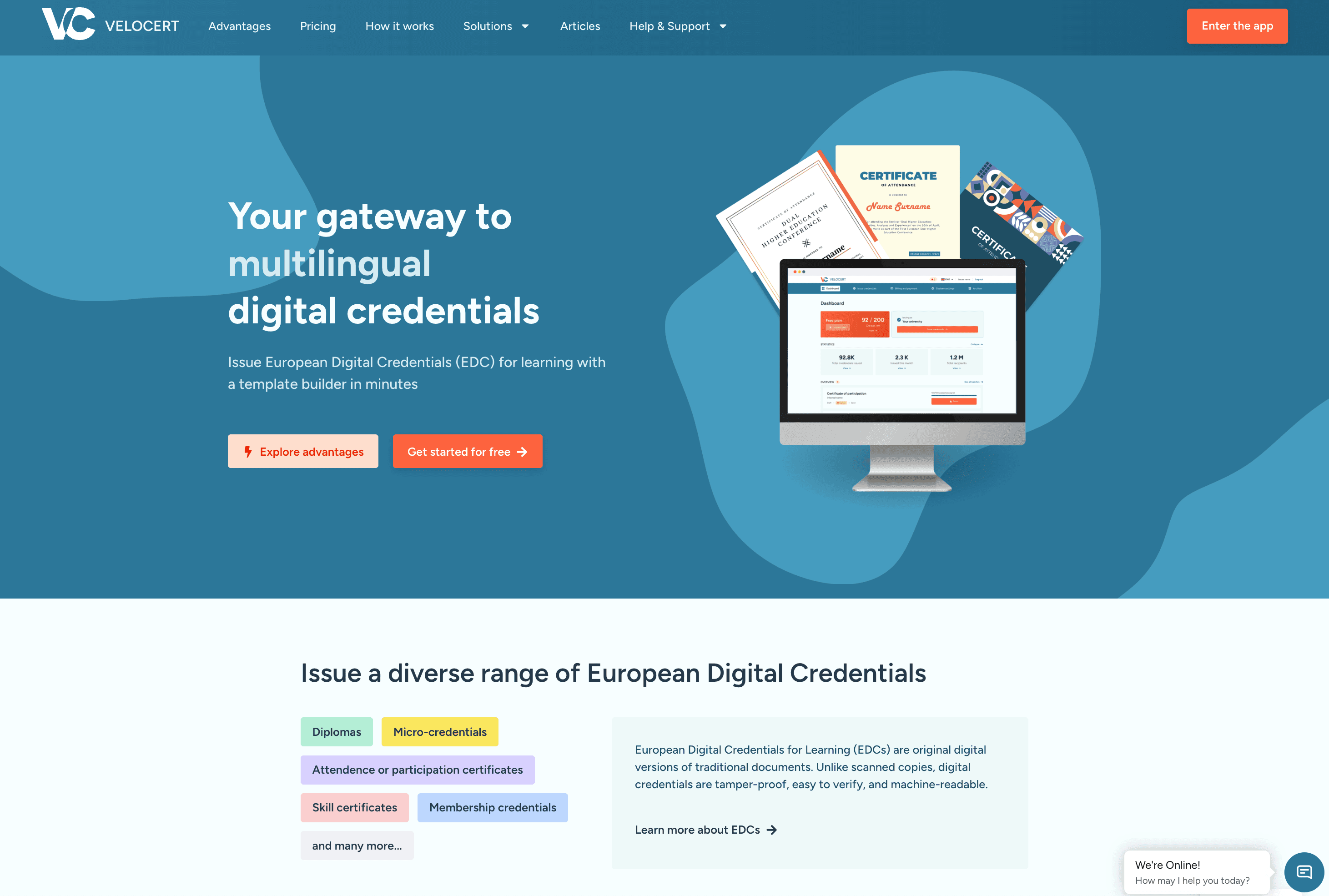
Landing page of Velocert.com
The solution
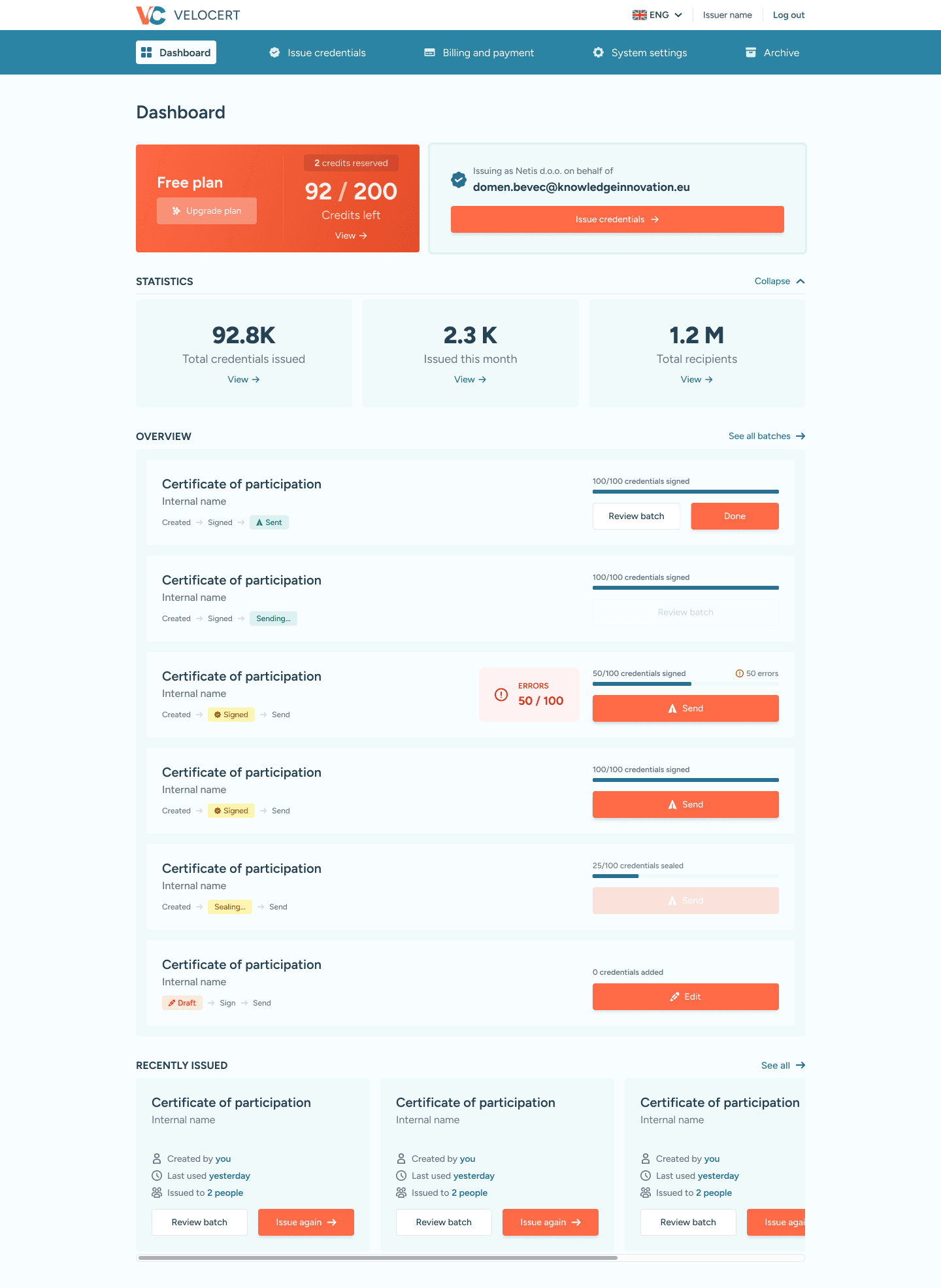
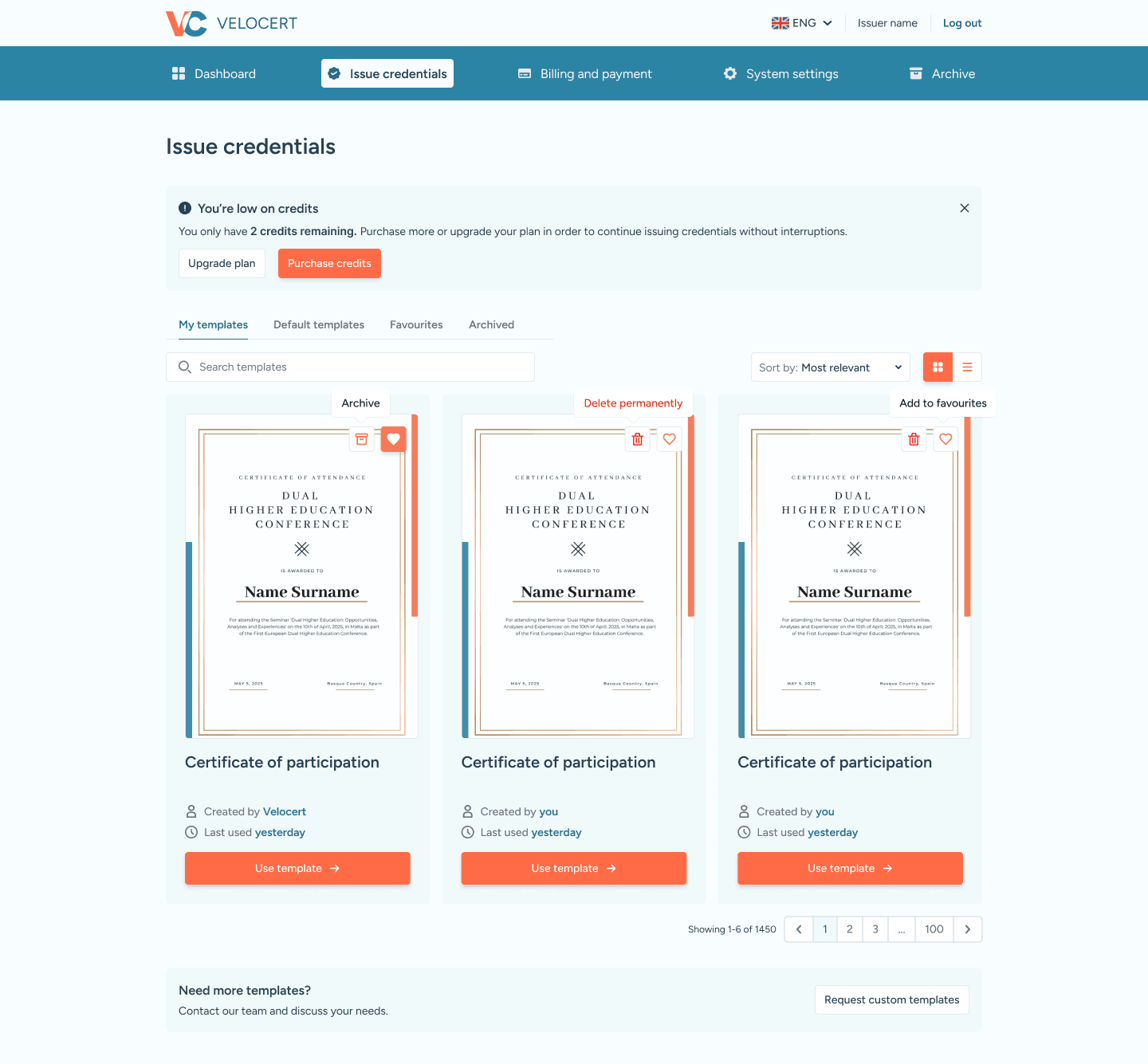
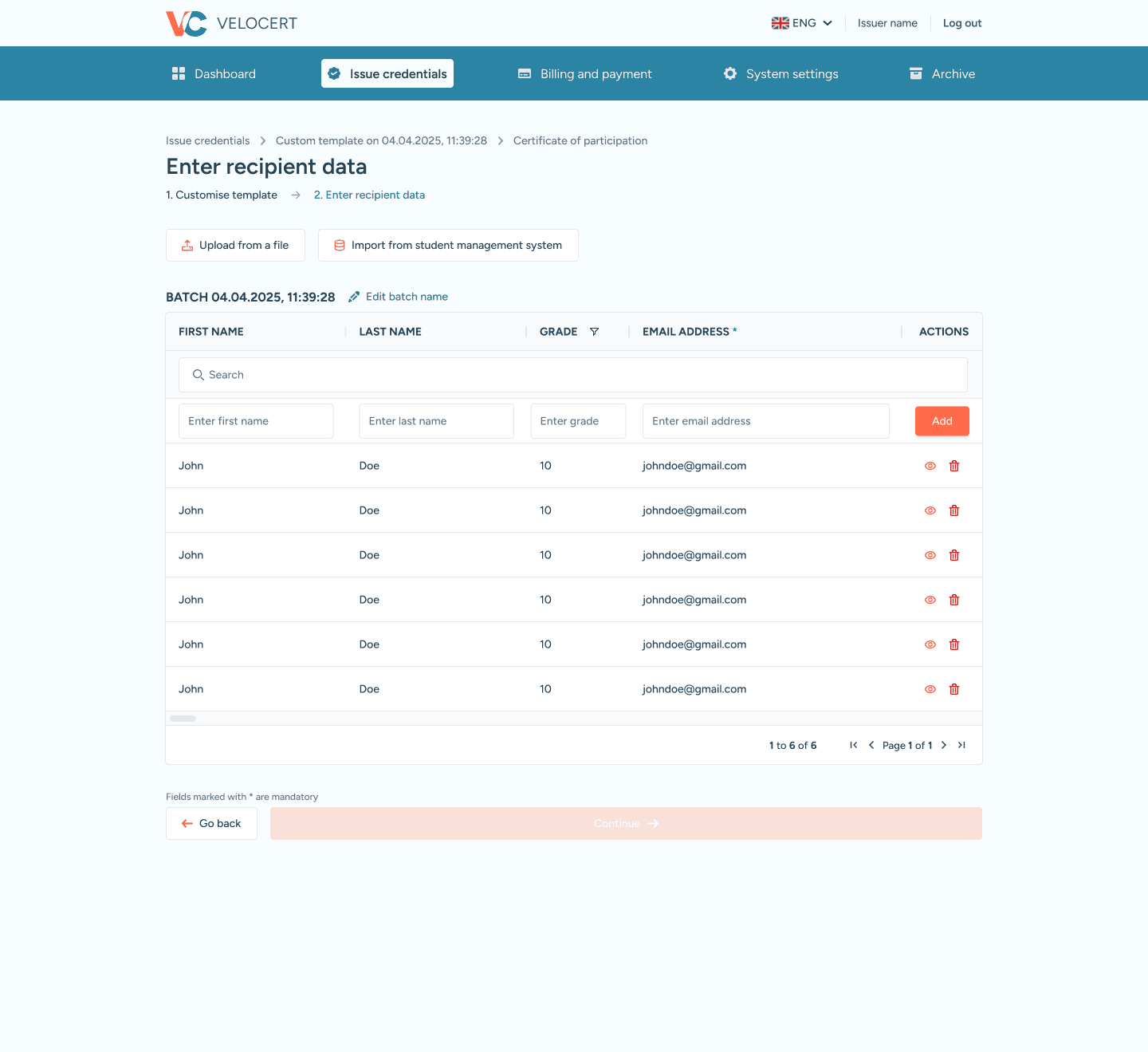
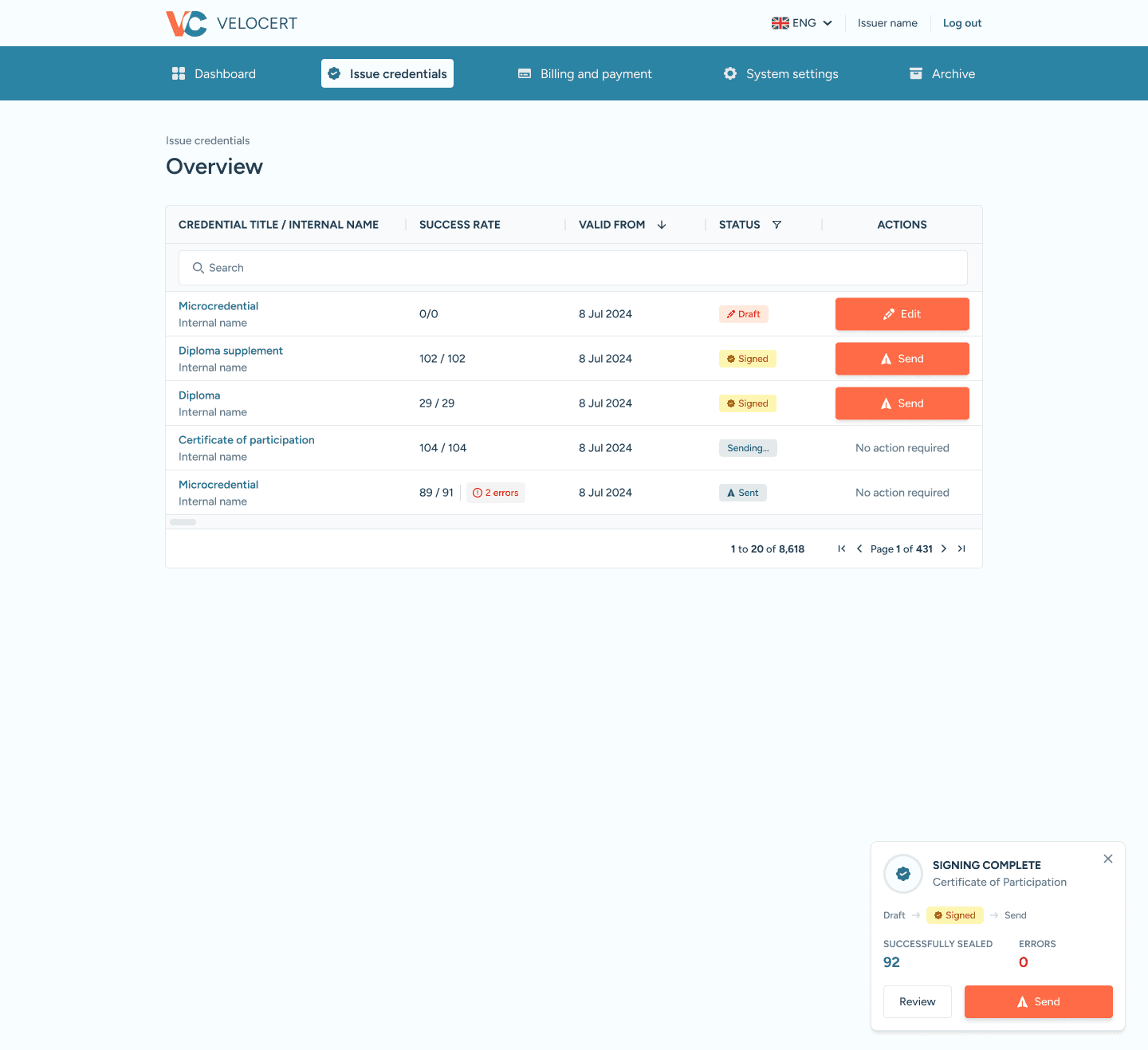
The Velocert platform walks users through three steps: pick a template, customise the credential content and styling, then import recipients and send. Key design decisions:
Template-first approach
Instead of starting from a blank credential with hundreds of possible fields, users choose a template (micro-credential, diploma, certificate of attendance, etc.) that comes pre-loaded with the right fields. This removes the biggest barrier for non-technical users.
Smart field defaults
Each template pre-sets which fields are visible, which are hidden, and which are fixed vs. variable. Users can adjust this, but the defaults are designed so that most users never need to.
Whitelabel-ready design
The platform was built to be brandable. Mondragon University, for example, uses a version with their own colours and branding. The component-based design system makes this straightforward.
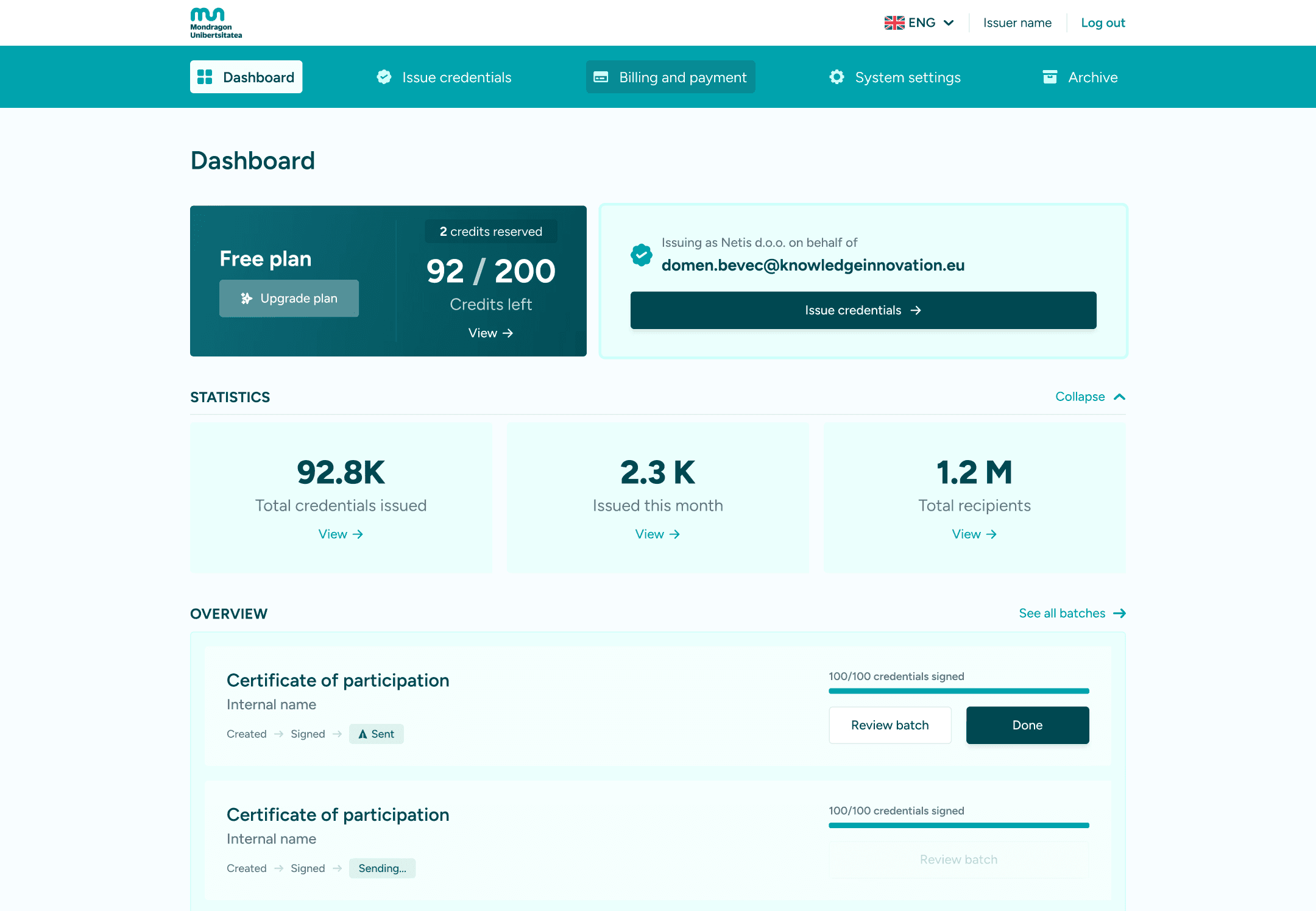
Whitelabeled enterprise version of Velocert with the colors of Mondragon University
Outcome
Velocert is in its soft-launch phase. Even so, early signals are strong:
The platform was selected to issue verifiable Proofs of Attendance at the Silver Bullet Risk Management Conference in Slovenia, issuing credentials to nearly 100 participants. It has been presented at MCMC 2025 in Zagreb, EduTech in Slovenia, MCMC 2026 in Amsterdam, and the W3C in London.
The website has generated inbound interest from organisations we never contacted, including a collaboration request from a Turkish organisation (the Microcredentials Association of Turkey), an inquiry from a Philippines-based maritime training centre issuing 25,000 certificates per year, and conference invitations from the Middle East. All unprompted, all driven by the website content alone.

Velocert being presented at MCMC 26 in Amsterdam
Screenshots